Your Revenue Cycle Is Bleeding Out Before Claims Ever Get Denied
Healthcare providers lose billions every year to claim denials. But the vast majority were preventable — not in theory, but with the right information at the right time. That’s the problem Kustode was built to solve.
Industry data tells a clear story. Initial denial rates climbed to nearly 12% in 2024. Over half of providers say denials are getting worse, not better. And roughly three out of four denied claims fail for administrative reasons — paperwork errors, missing authorizations, eligibility gaps — not because the care wasn’t medically necessary.
That means the system isn’t broken because payers are rejecting legitimate care. It’s broken because providers are submitting claims without the information they need to get them right the first time.
That’s the problem Kustode was built to solve.
The Real Cost Isn’t the Denied Claim — It’s Everything Around It
When a claim gets denied, the visible cost is the unpaid amount. But the actual damage runs deeper.
Staff spend hours researching denial reasons, correcting errors, and resubmitting. Each reworked claim costs providers an estimated $25 to $118 in administrative labor. Multiply that across hundreds or thousands of denials per month, and you’re looking at a significant drag on revenue that never shows up as a line item.
For specialty practices — mental health groups, home health agencies, skilled nursing facilities — the problem compounds. These verticals deal with session-based billing, payer-specific authorization rules, complex documentation requirements, and coding nuances that generic RCM tools simply don’t account for.
A mental health practice billing a 53-minute psychotherapy session under the wrong CPT code doesn’t just lose that claim. They trigger a pattern of denials that cascades through their revenue cycle for weeks. A home health agency that misses an EVV compliance window doesn’t just face a single rejected visit — they risk an entire episode of care.
Prevention Beats Recovery. Every Time.
Most revenue cycle tools are built to help you after things go wrong. They track denials, manage appeals, and report on what happened last quarter. That’s useful, but it’s reactive. You’re already losing money by the time those tools kick in.
Kustode works upstream. We built the platform around a simple principle: if you can identify revenue risk before a claim is submitted, you can prevent the denial from ever happening.
Here’s how that works in practice.
Real-Time Eligibility Verification
Eligibility gaps are one of the top drivers of claim denials across every specialty. A patient’s coverage changes, a plan terminates, or benefits shift between visits — and the claim fails before anyone realizes there was a problem.
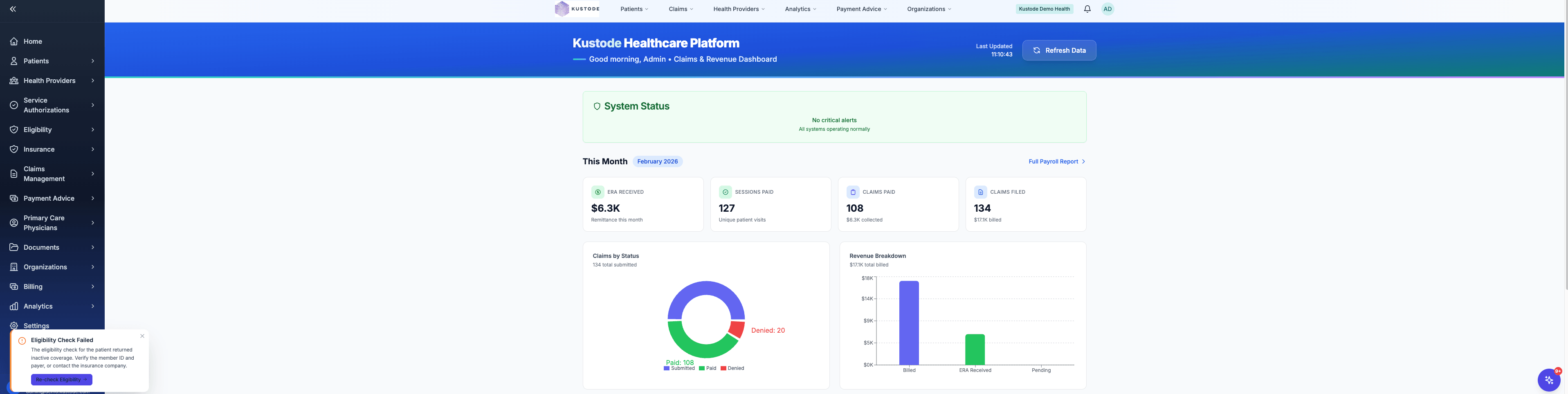
Kustode runs eligibility verification in real time, not as a batch process or a manual check. Before a service is rendered, the platform confirms active coverage, benefit details, and payer-specific requirements. If a check fails, you know immediately — the system surfaces an alert right on your dashboard so your team can resolve it before the visit happens, not after a claim bounces back weeks later.
For mental health practices dealing with session-based billing across multiple payers, this alone eliminates a significant category of preventable denials.
AI-Powered Claims Analytics and Denial Prevention
This is where Kustode goes beyond basic claims management. The platform’s Enhanced Claims Analytics engine doesn’t just report on what happened — it tells you why it happened, how confident it is in that analysis, and exactly what to do about it.
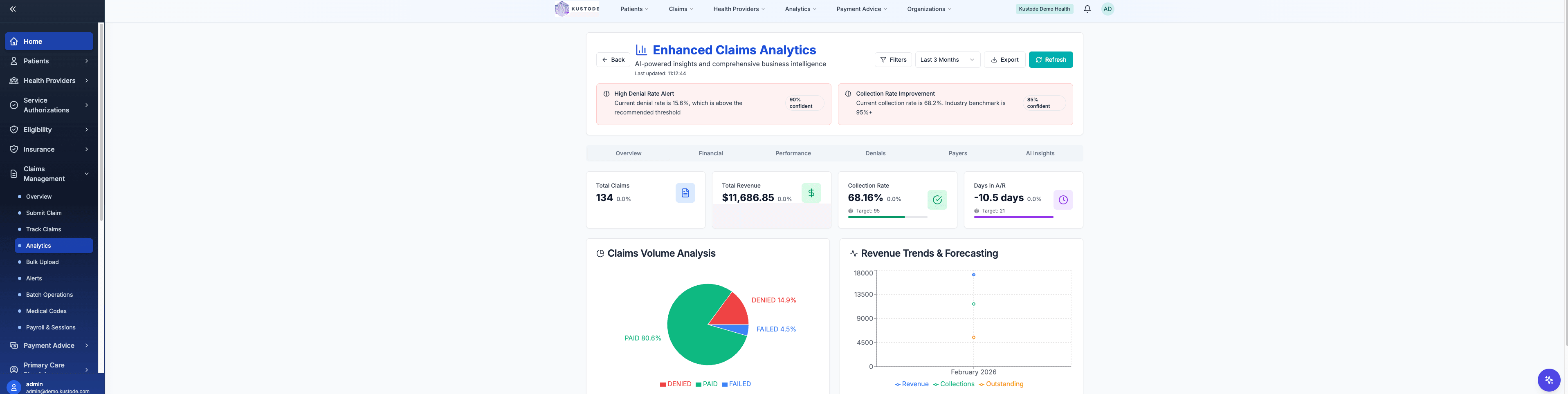
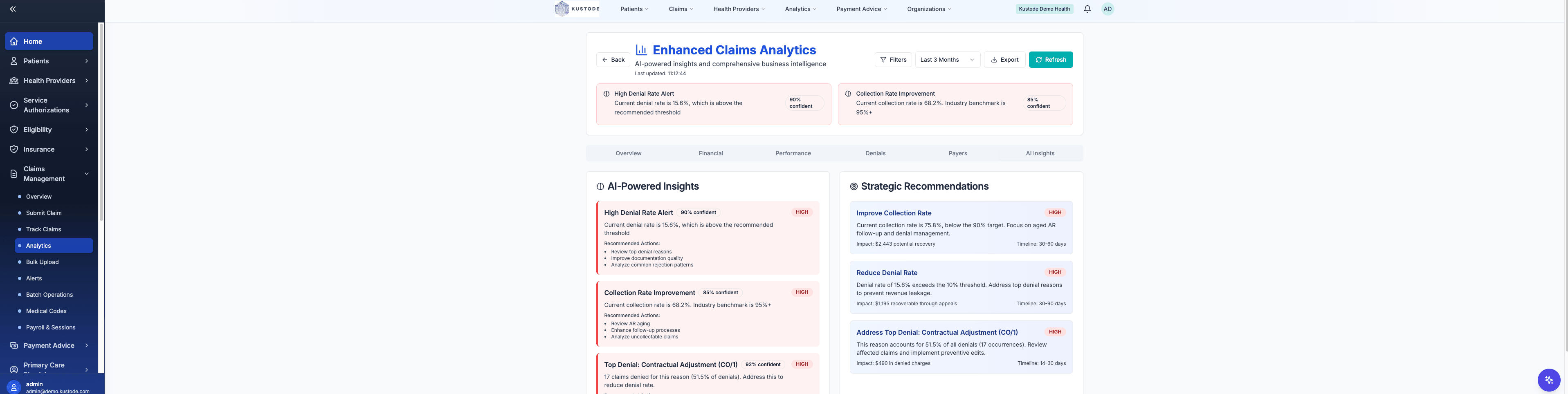
When your denial rate crosses a threshold, Kustode flags it with a confidence-scored alert. Not a generic warning — a specific insight like “your current denial rate is 15.6%, which is above the recommended threshold” with a 90% confidence rating. Alongside it, you’ll see the top denial reasons broken down by category, denial rate trends over time, and a clear picture of where your revenue is leaking.

But the real value is in the AI-powered recommendations. The platform generates strategic, prioritized action items: which denial categories to address first, estimated revenue impact of each fix, and realistic timelines for improvement. It’s the difference between knowing you have a problem and knowing exactly which lever to pull.
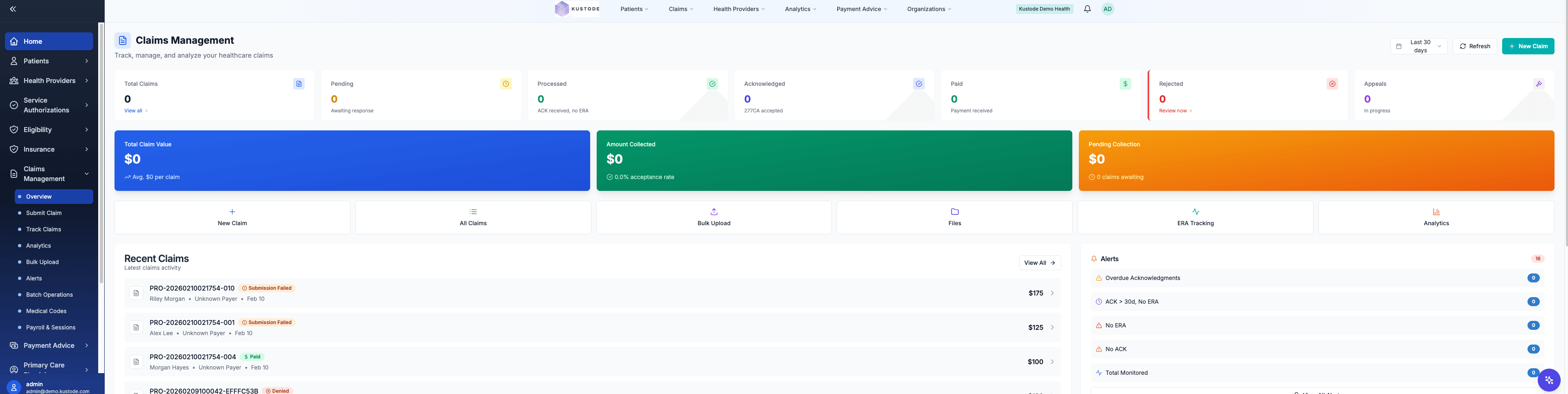
The system also tracks claims through every stage of the lifecycle — submitted, pending, processed, acknowledged, paid, rejected, and appeals — so nothing falls through the cracks. You can see your total claim value, amount collected, and pending collection at a glance, with alerts for overdue acknowledgments, missing ERAs, and stalled claims.
Payer Performance Intelligence
Not all payers are created equal, and your revenue strategy shouldn’t treat them like they are.
Kustode’s Payer Performance Analysis breaks down every payer relationship across the metrics that matter: claims volume, total revenue, collection rate, average payment days, denial rate, and an overall performance score. You can see at a glance that Aetna is paying in 6 days with a 6.9% denial rate while United Healthcare is taking 13 days with a 23.1% denial rate — and make informed decisions about how to allocate your team’s follow-up time.

This kind of payer-level intelligence is what turns reactive denial management into proactive revenue optimization. When you know which payers are consistently problematic, you can adjust your documentation, coding, and submission processes before claims go out the door.
Prior Authorization Tracking
Prior auth is where specialty practices lose the most time and the most money. Mental health providers deal with session-by-session reauthorization from payers like UnitedHealthcare and Cigna. Home health agencies navigate episode-level authorizations that vary by payer and by state. Miss a renewal window by a day, and you’re eating the cost of care you’ve already delivered.
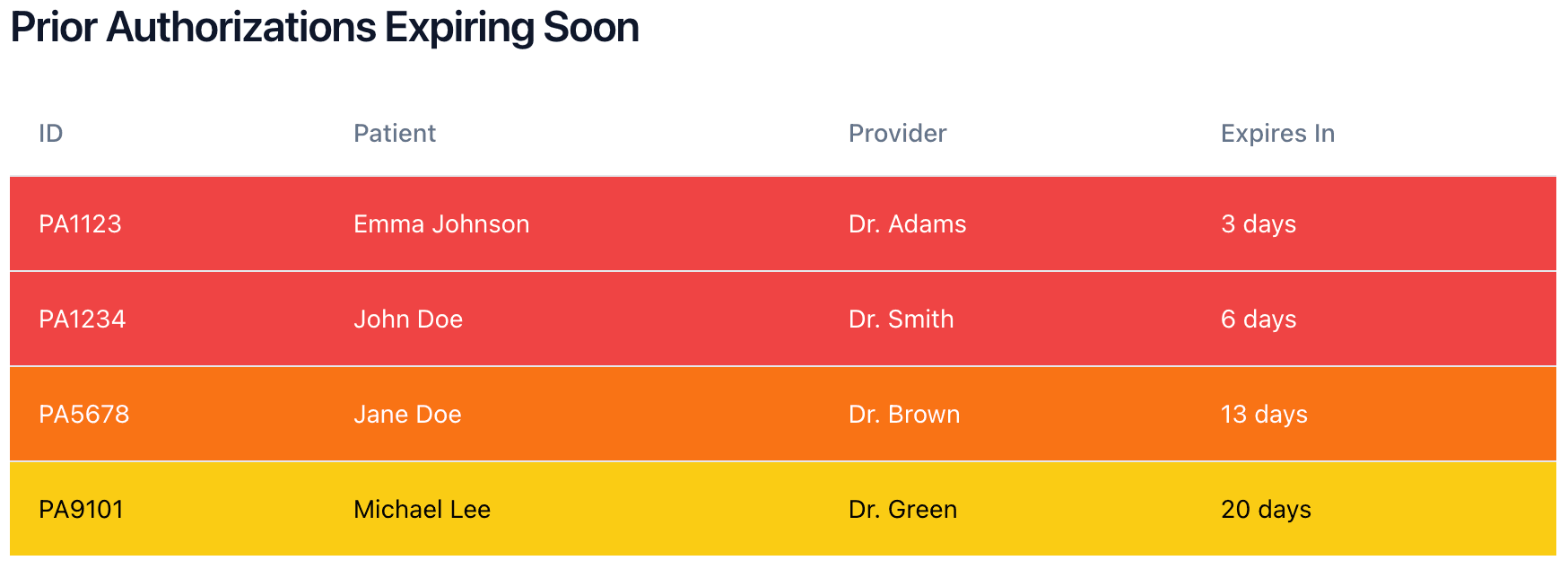
Kustode tracks authorization status across every active patient and every payer, with automated alerts before expirations hit. The platform doesn’t just tell you an auth is expiring — it tells you which patients need action, what the payer requires, and what documentation you need to submit.
Financial Reporting That Actually Drives Decisions
Most billing reports tell you what already happened. Kustode’s Financial Reports and Analysis suite is built to help you act on what’s happening now and anticipate what’s coming next.
The platform gives you a complete financial picture across six dimensions: executive summary, aging analysis, collections, payer performance, revenue cycle, and variance analysis. You’re not just seeing your collection rate — you’re seeing it benchmarked against industry averages. You’re not just tracking revenue — you’re comparing actual performance against budget with clear variance percentages.

Revenue cycle KPIs like first pass resolution rate, clean claim rate, days to payment, and cost to collect are tracked continuously, not calculated manually at the end of the quarter.

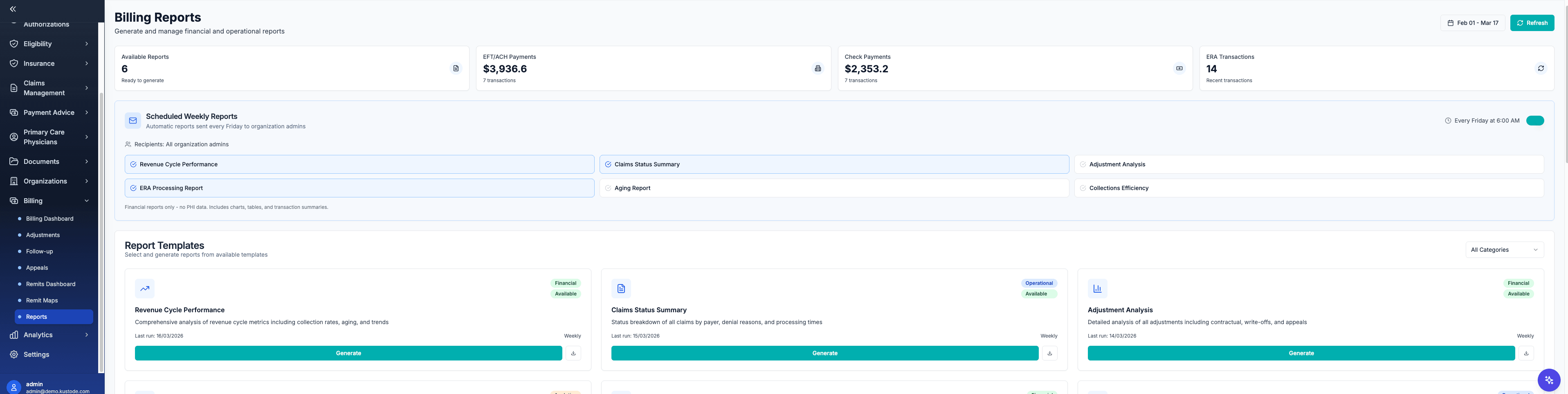
And with scheduled weekly reports delivered automatically to your team, everyone stays aligned on where things stand without chasing down spreadsheets.
ML Intelligence and Business Performance Scoring
Kustode’s ML Intelligence Dashboard gives you a single, quantified view of your practice’s revenue cycle health. The Business Performance Score evaluates your organization across revenue, claims, denials, and A/R health — giving you a composite score and letter grade that makes it immediately clear where you stand.

The Growth Trajectory module tracks monthly revenue, month-over-month and quarter-over-quarter growth, and projections. Risk Alerts surface high-risk payers, likely denials, and revenue at risk before they become real losses.
This is what we mean by autonomous revenue intelligence. It’s not a dashboard you have to interpret — it’s a system that interprets your data for you and tells you what to do next.
Built for the Practices That Generic Tools Overlook
Enterprise RCM platforms are designed for large health systems. They work well at scale, but they treat a mental health group practice the same way they treat a cardiac surgery center. The billing logic, the payer rules, the compliance requirements — they’re fundamentally different.
On the other end, basic billing software handles claims submission but doesn’t do anything to prevent denials. You’re left manually checking eligibility, tracking authorizations in spreadsheets, and finding out about payer changes when the denials start rolling in.
Kustode sits in the middle. We’re purpose-built for the verticals where denial prevention matters most and where generic approaches fall short: mental health and behavioral health practices, home health agencies, and skilled nursing facilities.
Every feature, every payer integration, every risk model is informed by the specific billing patterns, documentation requirements, and compliance realities of these specialties.

What This Looks Like in Practice
A mid-size behavioral health group running 500+ sessions per week can’t afford to manually verify eligibility for every patient at every visit. They can’t track prior auth renewals for three different payers with three different rules in a shared spreadsheet. And they definitely can’t keep up with payer policy changes that affect how they code and document each session type.
With Kustode, eligibility is verified automatically. Auth renewals are tracked and flagged before they expire. Claims are scored for risk before submission. Payer performance is quantified and compared. Financial reports are generated and delivered weekly. And AI-powered insights surface the specific actions that will have the highest impact on your revenue — with confidence scores, estimated dollar impact, and clear timelines.
The result isn’t just fewer denials.
It’s a revenue cycle that runs with less friction, less rework, and less uncertainty about whether you’re going to get paid for the care you’ve already provided.
Revenue Intelligence, Not Revenue Recovery
The healthcare industry has spent years investing in better ways to recover from denials. Better appeals workflows. Faster rework processes. More detailed denial analytics.
All of that matters. But the highest-leverage move is preventing the denial from happening in the first place.
That’s what Kustode delivers: autonomous revenue intelligence that works upstream of the problem, built specifically for the practices that need it most.
If your practice is tired of chasing denials that should never have happened, we should talk.